About OverpayingForAI
Last updated: June 2026
The $200 Mistake
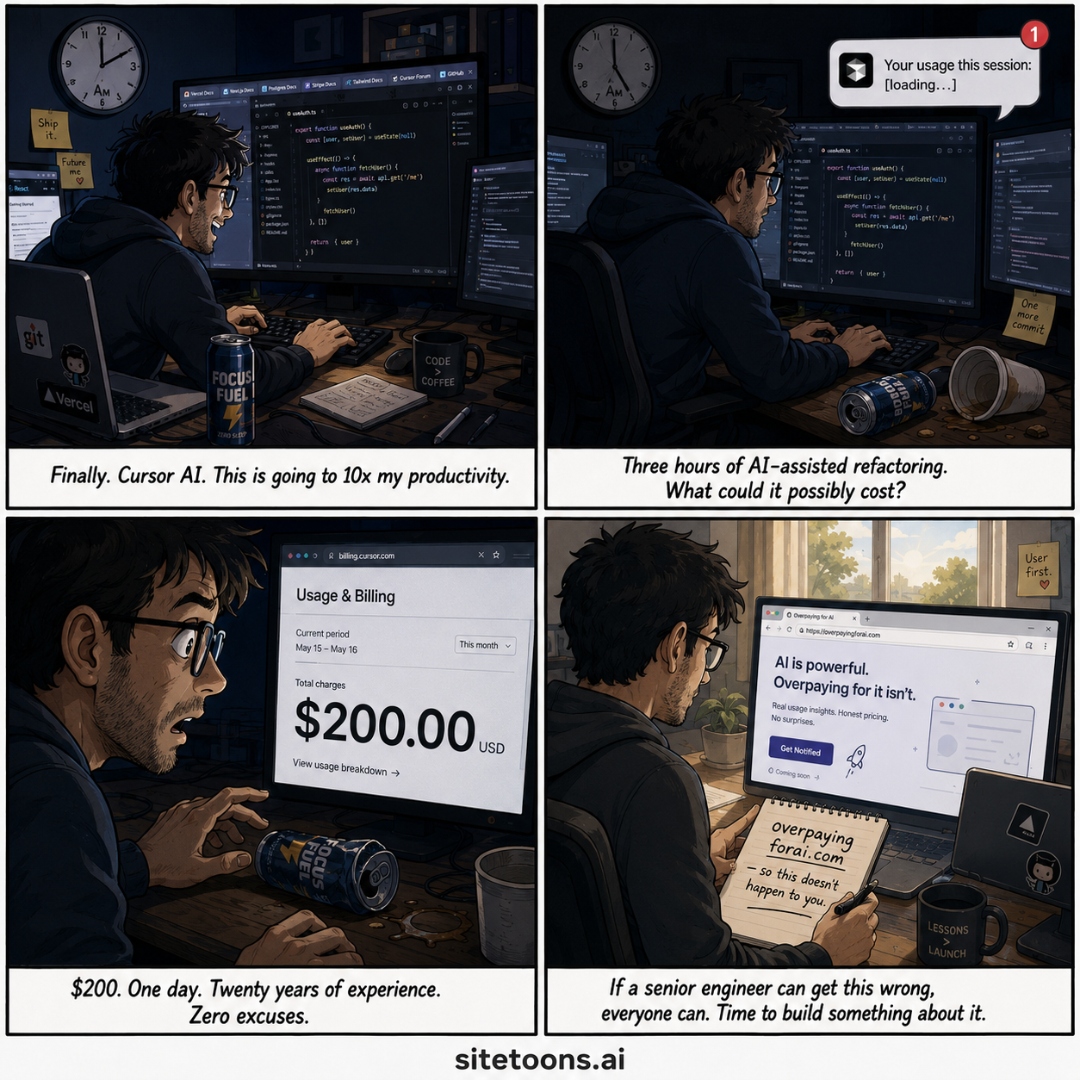
It happened on a single day — or more accurately, a day bleeding into night. A Cursor trial. Some ambitious refactoring. The kind of session where you're deep in the problem and not watching the meter.
By the time it was over, the bill was $200 USD. One day. One engineer.
That engineer had been writing software for over 20 years. He understood how APIs work. He understood tokens, vaguely, in the abstract. What he hadn't done was sit down beforehand and actually calculate what that session would cost — which model was running, how many tokens each request consumed, whether he was on a plan that capped things or one that didn't. He assumed it would be fine. It was not fine.
The Realization
Here's the part that matters: a senior engineer with two decades of experience made this mistake. Not a casual user stumbling into AI for the first time. Someone who should have known better, and didn't — because the pricing is genuinely opaque, the model choices are numerous, and the defaults are not always the cheapest option.
If that can happen to someone with context and experience, it can get seriously out of hand for anyone who picks up an AI tool without doing the math first. The wrong model for the wrong workload, billed per token with no ceiling, adds up faster than almost any other software expense category. Most people don't find out until they open the statement.
What We Built
This site exists to do the math before the statement arrives.
OverpayingForAI tracks pricing for 55+ AI tools, updated weekly from official provider pages. It includes an interactive cost calculator — enter your monthly usage, get your real spend across models, plus ranked alternatives that cost less. A decision engine narrows the field to a specific recommendation based on your use case in five questions. Thirty comparison pages cover the most common switching decisions. Pricing freshness is shown on every page, so you know whether the number you're looking at was checked this week or six months ago.
The goal is not to find the cheapest model. It's to find the cheapest model that actually does the job.
How We Verify Data
All pricing is sourced from official provider pages — not third-party aggregators, not press releases. An automated pipeline checks figures weekly. Every pricing page shows when data was last reviewed.
If something is wrong, we want to know. Pricing changes without warning and providers don't always announce it. There's a contact page for corrections and it gets read.
Free by Design
The site was built using free tools wherever possible — Kilo Code for development, open-source models via OpenRouter for the build itself. That created its own lesson: free models work well up to a point. Beyond that threshold, you need paid models — just the right ones, at the right cost, for the right task. Which, as it turns out, is exactly what the site is about.
The site is free to use. No sign-up required. No paywall on the calculator or the data. If you want to help keep it that way, there is a support page.
There's a certain irony in running an AI cost site on a minimal infrastructure budget. The irony is intentional.
Independence
Where affiliate relationships exist, they are disclosed — see our affiliate disclosure. No provider has paid to improve their ranking or alter their pricing data. Recommendations follow one criterion: sufficient quality at the lowest verifiable price.
That's the whole methodology.
Questions or pricing corrections → contact page